
 Español
 GCR and Fundació Santa Teresa: the part of the circular chain that isn’t always visible
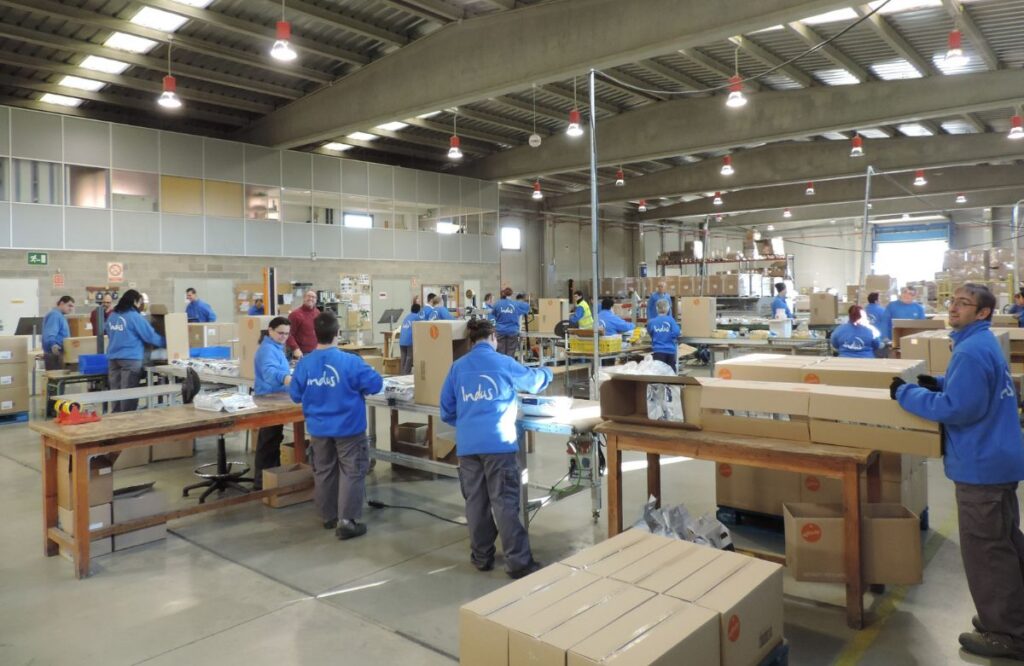
August 2026 — Not every part of the circular economy happens inside a production facility. Some of it happens just a few kilometres away, at the Special Employment Centre of Fundació Santa Teresa del Vendrell. There, circular economy and inclusive employment come together through the daily work of a highly precise team. Two or three workers arrive every morning, set up their machine and carry out a process with almost no margin for error.
GCR has worked with Fundació Santa Teresa since 2019. What began as a grounds maintenance service has become part of GCR’s production chain. Over time, the collaboration has grown through consistent commitment from both organisations.
How it started
In 2019, GCR saw an opportunity to improve waste management in the common areas of its La Bisbal del Penedès site.
Fundació Santa Teresa offered its support. The non-profit organisation, based in Baix Penedès, supports people with disabilities and people at risk of social exclusion.
The relationship developed from there.
During the COVID-19 pandemic, GCR needed support to prepare non-woven medical gowns for recycling. The process required time and precision, and GCR could not absorb it internally. Fundació Santa Teresa stepped in.
By 2023, the collaboration had become part of GCR’s industrial production activities.
Circular economy and inclusive employment in practice
Today, the Special Employment Centre (CET) forms part of GCR’s circular production chain.
Its team separates cardboard cores from plastic film through manual and semi-automated steps. This work recovers a cleaner plastic feedstock for GCR’s recycling and transformation process.
Two to three people with disabilities carry out this activity for three to four hours each day. They work on it throughout the year, with a near-zero error rate.
When the team builds its own tools
One of the most significant aspects of the collaboration is the machinery itself.
The team designed and adapted two machines around the needs of the people using them. As a result, any worker at the centre can operate the equipment independently, safely and effectively.
This approach reduces process risk while removing barriers to participation.
No external engineering brief defined the solution. Instead, the people who understood the work shaped the tools around those doing it.
“I really like working on the GCR activity. I can focus. And the machine is so easy to use.” — Salva, worker at the Special Employment Centre, Fundació Santa Teresa del Vendrell
By the numbers
— 6+ years of continuous collaboration
— 2–3 workers with disabilities in stable, year-round employment
— 3–4 hours of daily activity throughout the year
— Near-zero error rate
Circularity is also about people
Companies often measure circularity in tonnes recovered or CO₂ emissions avoided. Those metrics matter, but they do not tell the whole story.
Circularity also means looking at who participates in the value chain. It means considering the conditions that make that participation possible and sustainable over time.
The collaboration between GCR and Fundació Santa Teresa shows how circular economy and inclusive employment can reinforce each other. It has grown steadily, year after year, through commitment from both organisations.
By integrating the Special Employment Centre into its production chain, GCR helps recover plastic materials for recycling. At the same time, the collaboration supports stable employment for people whom industrial value chains too often leave out.
We are grateful to the entire team at Fundació Santa Teresa, and especially to Nacho, Rafael and Salva, for making this work every day.
For more information about Fundació Santa Teresa del Vendrell and its work, visit fundaciosantateresa.org.